Loading...
← All destinations
South Coast, NSW
Wollongong & Grand Pacific Drive
Sea cliff bridge & an easy coastal escape
About this place
Last updated: 15/10/2026
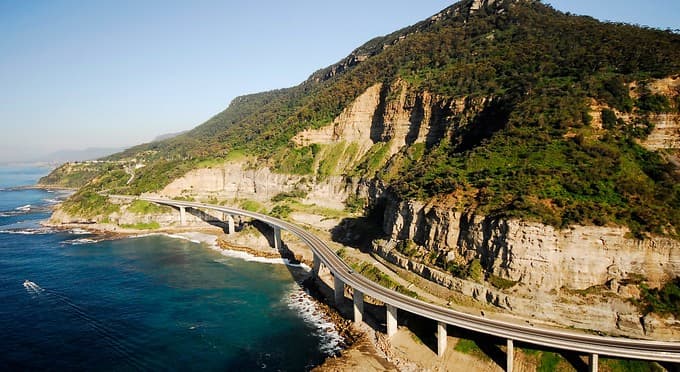
Just an hour south of Sydney, Wollongong is NSW's third-largest city but feels more like a beach town. The famous Sea Cliff Bridge arches out over the ocean and is one of Australia's most photographed coastal roads.
Beyond the bridge: the Illawarra escarpment's waterfalls, the Buddhist Nan Tien Temple (the largest in the southern hemisphere), and a string of surf beaches that locals keep quiet about.
Highlights
Sea Cliff Bridge drive
Nan Tien Temple (largest in southern hemisphere)
Illawarra escarpment waterfalls
Austinmer & Thirroul surf beaches
Attractions
What to see, how long to spend, and roughly what it costs.
Sea Cliff Bridge drive
1.5 hrs (incl. stops)Free
5km coastal arch at 45m above the ocean, north of Wollongong on Grand Pacific Drive — pair with a coffee stop at Stanwell Park beach below.
Nan Tien Temple
2 hrsFree (workshops attract a fee)
Buddhist temple in Dapto, described as the largest in Australia — Chinese-style architecture, gardens, a quiet café, and a guesthouse for overnight retreats.
Austinmer or Thirroul surf
Half dayFree if you have a board
Two beach towns north of the city centre with quieter, more local-style surf breaks than the Sydney beaches — beginners can rent boards from the surf school on the headland.
How to get there
By train - and here it genuinely is the easy option: Wollongong sits on the electrified South Coast Line (SCO), so the trains run straight through the city on their way to Kiama: no diesel branch, no connection, nothing to book.
They leave from Central, and in the peaks and on weekends they start back at Bondi Junction or Martin Place and call at Central (platform 25), while off-peak they start at Central itself.
Central to Wollongong is roughly 85-95 minutes on the faster services, and trains run about every 30 minutes through the day with more in the peaks.
It is all Opal or contactless - tap on and off, no paper ticket. Two stations serve the city: North Wollongong is the one for the beach, a few minutes' walk downhill to the sand, and Wollongong station is the one for the CBD.
Opal fares and the daily cap: Fares are distance-banded and then capped, rather than a flat regional fare. The adult Opal daily cap is $19.30 Monday to Thursday and $9.65 on Friday, Saturday, Sunday and public holidays, with a $50 weekly cap - the 2025-26 figures, since adult fares rose on 14 July 2025.
We have not been able to verify the current single-trip fare for the Wollongong distance band, so budget against the caps rather than a quoted single fare: a weekday return from Central lands at or inside the $19.30 cap, and a Friday-to-Sunday one is capped at $9.65.
By car: the M1 Princes Motorway south, out through Heathcote Road or the Princes Highway, then down Mount Ousley into the city. Allow about 1h15 off-peak and 1h45 or more in the morning and evening peaks.
The train skips the Mount Ousley descent, which is where the traffic actually bunches.
The Grand Pacific Drive and the Sea Cliff Bridge: To make the trip a scenic one rather than a motorway run, leave the M1 south of Sutherland and take the Grand Pacific Drive - through the Royal National Park to Stanwell Tops, then Lawrence Hargrave Drive along the cliffs.
The Sea Cliff Bridge is the 665m section of that road, opened in December 2005 after the old cliff road kept collapsing, and it is carried out over the sea on a cantilever.
It is a drive-across rather than a walk-across: the bridge carries two lanes of traffic and there is nowhere to stop on it, so the way to take it in is from the wheel, and the best view of it is from above at the Stanwell Tops and Bald Hill lookouts.
If you do want to be on foot, park at Coalcliff or Clifton at either end and walk on - there is a shared pedestrian and cycle path along the seaward side, and Coalcliff station is a steep 15-minute walk from the bridge.
The free Gong Shuttle - the single most useful local fact on this page: Wollongong runs a fare-free bus loop, routes 55A and 55C, linking Wollongong station with the hospital, TAFE, the university and the beaches by way of the CBD and Burelli Street.
Weekdays it runs every 10 minutes from 7am to 6pm and every 20 minutes from 6pm to 10pm; Saturdays every 20 minutes from 9am to 5:20pm; Sundays and public holidays from 9:40am to 5:20pm, up to a 20-minute frequency.
It is funded through to June 2027. Arrive by train, leave the car where it is, and use it to move between the station, the beach and the city centre for nothing - but check the hours, because the evening and weekend service is much thinner than the weekday one.
Best time to visit
Spring (Sep-Nov): mild 15-24C days, and the pick of the year for the escarpment: the waterfalls below Mount Keira and Mount Kembla run well after the winter rain, the rainforest tracks are green and the beaches are quiet. The water is still a step too cold for long swims.
Summer (Dec-Feb): the beach season, and the only time most visitors swim comfortably, with water around 21-23C. It is also the busiest: the school holidays from mid-December to late January fill the foreshore, the beach car parks and the Nan Tien Temple, and the city gets hot and humid on the days the wind comes off the land. Book ahead and start early.
Autumn (Mar-May): the settled middle. Still warm enough to swim in March and April, quieter once the school holidays end, and the best season for the escarpment walks as the heat drops away. The whale migration starts to show from the headlands in May.
Winter (Jun-Aug): cool 12-18C days, empty beaches and the peak of the humpback season - the headlands at Flagstaff Point and Bass Point are where locals watch them pass.
It is also the season for walking the escarpment without sweating, though the tracks are muddy for a day or two after rain and some close when it has been heavy.
The Illawarra's own weather quirks: the escarpment behind the city shapes the weather rather than just framing it. Onshore easterlies are forced up the slope and drop their rain on the coastal strip, so the Illawarra records more rain days than Sydney, and it is common for Wollongong to sit under a low cloud band while the western suburbs are clear.
Rain falls mostly in the first half of the year, and a summer afternoon often brings a sea breeze strong enough to clear the beach by late afternoon.
Check the wind and the local forecast rather than the Sydney one, and if the coast is clouded in, the escarpment villages and the inland valleys behind it are often sunny.
Top things to do
1. Drive the Sea Cliff Bridge and the Grand Pacific Drive
The 665m bridge is the centrepiece of a 140km coastal drive from the Royal National Park down past Wollongong: leave the motorway at Loftus or Sutherland, run through Stanwell Tops and Coalcliff, and take the S-curve out over the sea.
Stop above it at Bald Hill for the hang gliders and the view back up the coast, then carry on through Thirroul and Austinmer.
2. Visit the Nan Tien Temple at Berkeley
The largest Buddhist temple in the Southern Hemisphere, a short drive south of the city centre and free to enter. Chinese-style halls, lotus ponds and gardens, a vegetarian cafe, and a guesthouse for overnight stays; the pilgrim lodge and workshops carry fees.
Allow two hours, and dress as you would for a working religious site.
3. Walk the Blue Mile along the foreshore
Five kilometres of continuous waterfront path from Wollongong harbour past the lighthouse at Flagstaff Point, Belmore Basin and the beach to North Wollongong. Flat, free and the best way to understand the city in an hour - plus it is where the locals run, swim and eat.
4. Swim at Austinmer and Thirroul
The northern beach towns are quieter and more local than the city beaches, and both have ocean rock pools cut into the headlands that fill at high tide - free, sheltered and the best swim in the Illawarra when the surf is up. Boards and wetsuits can be hired locally.
5. Walk the Illawarra escarpment above the city
Mount Keira and Mount Kembla sit directly behind Wollongong, with rainforest ring tracks, waterfalls and lookouts that give you the whole coast and the city in one frame.
Cooler and greener than the beach in the hot months, and muddy for a day or two after rain.
6. Watch whales from the headland, May to November
Humpbacks run north between May and July and south again from September to November, and the headlands at Flagstaff Point, Bulli and Bass Point put them within a few hundred metres of shore.
Bring binoculars; the lighthouse at Flagstaff Point is the easiest vantage point in the city.
7. Go inland to Minnamurra Rainforest and Jamberoo
Half an hour inland from the coast, the Minnamurra Rainforest Centre has a boardwalk through real subtropical rainforest to a waterfall, and Jamberoo next door is the valley village. A good wet-weather or windy-day alternative when the beaches are unpleasant.
Pro tips
Take the train - and get off at the right station
Wollongong is on the electrified South Coast Line, so it needs no connection and no booking, unlike everywhere further down the coast. North Wollongong station is the one for the beach; Wollongong station is the one for the CBD.
Check the timetable the evening before, because weekend trackwork on the Illawarra line replaces trains with buses and adds a lot of time.
Go Friday to Sunday for the $9.65 daily fare cap
Adult Opal travel is capped at $19.30 Monday to Thursday but only $9.65 from Friday to Sunday and on public holidays (2025-26 fares). A day trip from Central is therefore roughly half price on a weekend - the same trick that works for the Blue Mountains.
Use the free Gong Shuttle instead of hunting for parking
Routes 55A and 55C loop between the station, the hospital, TAFE, the university and the beaches for nothing. It runs every 10 minutes on a weekday from 7am to 6pm and every 20 minutes to 10pm, but weekends start from about 9am and finish by 5:20pm - plan the day around that, not around a late dinner in town.
Drive the bridge early, and don't rely on it at peak hour
The Sea Cliff Bridge is a two-lane road with nowhere to stop, and Lawrence Hargrave Drive backs up behind slow traffic on summer weekends. Go early, or on a weekday.
Coming back, the Mount Ousley climb northbound on a Sunday afternoon is the worst part of the trip - leave before mid-afternoon or take the train back.
Plan your trip
How many days do I need in Wollongong & Grand Pacific Drive?
1 day (drive the bridge + temple + beach) or a relaxed weekend
When is the best time to visit Wollongong & Grand Pacific Drive?
Year-round — autumn for the waterfalls, summer for beaches
How do I get to Wollongong & Grand Pacific Drive from Sydney?
Drive via the M1 (1hr). Train from Central to Wollongong (1.5hrs, $8 AUD Opal).
Getting there
Drive via the M1 (1hr). Train from Central to Wollongong (1.5hrs, $8 AUD Opal).
Best time to visit
Year-round — autumn for the waterfalls, summer for beaches
Suggested stay
1 day (drive the bridge + temple + beach) or a relaxed weekend
More places to explore
Keep reading
Related guides
Plan your Sydney trip
Build a Wollongong & Grand Pacific Drive day trip out of a Sydney base — pick the train, pick the morning, pick the lookout.
Read guide →Getting around
Opal cards, train timetables, and car-hire tips for regional trips.
Read guide →Budget for the trip
Daily costs for couples, solo travellers, and families across NSW.
Read guide →